
InfographicsCompanies
Market Size (2026)
USD 545.0 Mn
Forecast (2036)
USD 1032.7 Mn
CAGR (2026 to 2036)
6.6%
How big is Vegan Makeup Market in 2026?
USD 545.0 Million in 2026 and USD 1,032.7 Million by 2036 at a 6.6% CAGR.
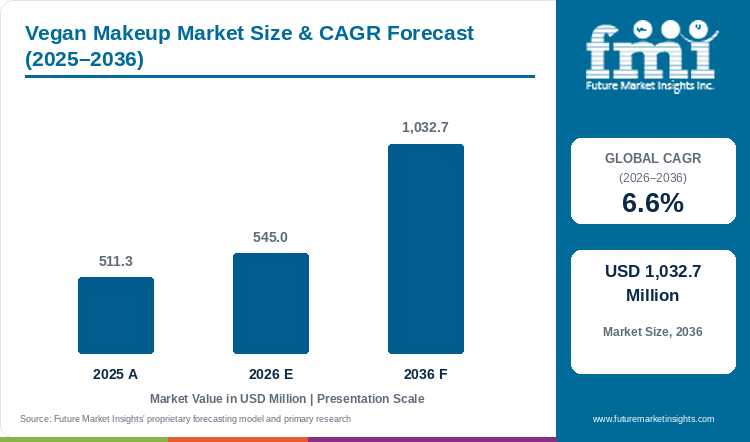
The Vegan Makeup Market is valued at USD 545.0 Million in 2026 and is forecast to reach USD 1,032.7 Million by 2036 at a 6.6% CAGR. The Vegan Makeup Market was valued at USD 511.3 Million in 2025. Buyers assess shade match and wear alongside proof that a formula contains no animal-derived ingredients. The Vegan Society reported more than 35,000 Vegan Trademark registrations across cosmetics and toiletries in April 2025. This count covers the wider beauty category. [2]
In the United States, MoCRA requires covered cosmetic facilities to register and responsible persons to list products and ingredients. EU markets apply common cosmetic-claims criteria and an animal-testing marketing ban. Gulf markets use national conformity or notification systems for product entry. [3][4][5][12][16]
Suppliers need ingredient-origin records and safety documentation before entering these channels. Animal-free positioning also extends across other beauty categories in the wider vegan cosmetics market.
Vegan Makeup Market Size & CAGR Forecast (2025-2036)
Global vegan makeup market value by year, with forecast growth rate
Year
Basis
Market value (USD million)
2025
Actual
511.3
2026
Estimate
545.0
2036
Forecast
1,032.7
CAGR, 2026 to 2036
6.6%
Key Takeaways
- Consumers and retailers increasingly look for clear support for animal-free ingredients and testing claims.
- Core / classic lines hold 35.0% of the market in 2026 as everyday face, eye and lip products support repeat purchase across price tiers.
- Conventional holds 50.0% of the Nature axis in 2026. Mainstream formulas and merchandising remain important within vegan makeup.
- Cream & balm holds 26.0% of the Format axis in 2026. These textures support blending and skin comfort in multi-use lip and complexion products.
- Claim documentation can slow product <a Oreal, Beiersdorf, Coty, Amorepacific, Unilever, and Shiseido.
Analyst Perspective
“Revenue realization depends less on ethical interest than on whether brands can document vegan claims while matching conventional expectations for shade choice and wear. Price and retail availability remain decisive.”
– , Principal Consultant, Future Market Insights
How is the vegan makeup market segmented?
The market is segmented by Product Type, Nature, Format, Price Positioning, and Sales Channel.
Product Type covers Core / classic lines, Targeted treatment lines, Sensitive & gentle lines, Premium & clinical lines, and Kits & sets. Nature covers Conventional, Vegan & cruelty-free, Natural & organic, Dermocosmetic / clinical, and Fragrance-free & sensitive. Format covers Cream & balm, Liquid & serum, Stick & solid, Spray & mist, Sheet & patch, and Powder. Price Positioning covers Mass, Masstige, Premium, and Professional. Sales Channel covers E-commerce & DTC, Specialty beauty retail, Pharmacies & drugstores, Supermarkets & hypermarkets, and Salons & spas.
What makes Core / classic lines central to the Product Type category?
Core / classic lines cover familiar everyday makeup that consumers replace regularly.
Product type
Share (2026)
Core / classic lines
35.0%
Other segments combined
65.0%*
Total
100.0%
Metric
Value
Global CAGR (2026 to 2036)
6.6%
Leading segment
Core / classic lines
- Core / classic lines account for 35.0% of 2026 revenue as routine makeup use supports a broad customer base and regular replenishment.
- Core / classic lines cover the makeup consumers use and replace regularly. Familiar application makes it easier to introduce vegan formulas into existing routines. A broad choice of shades and finishes also gives retailers a clear reason to stock these products. Everyday face and lip products share this repeat-purchase role with the wider colour cosmetics market.
- In August 2024, Estée Lauder Companies launched Smashbox in Amazon Premium Beauty. The announcement identified Photo Finish primer as vegan and cruelty-free, giving an established core product a wider digital audience. [6]
Why does Conventional lead the Nature category?
Mainstream formulations can meet vegan requirements while retaining familiar performance and pricing.
Conventional describes mainstream formulas and merchandising within this vegan makeup taxonomy. Buyers still expect color payoff and wear at a suitable price. Suppliers can meet those expectations with synthetic or plant-derived functional ingredients while excluding animal-derived inputs. Natural & organic and dermocosmetic positioning introduce additional formulation requirements. Ingredient-origin preferences are also central to the adjacent natural cosmetics market.
- Conventional represents 50.0% of the Nature axis in 2026. Mainstream performance and price expectations remain the main purchase benchmarks within vegan makeup.
What are the drivers, restraints and opportunities in the vegan makeup market?
Demand for verifiable animal-free formulas supports growth. Claim documentation and compliance across markets raise launch costs, while ingredient innovation helps suppliers retain familiar makeup performance.
- Driver: Independent vegan and cruelty-free verification helps shoppers assess unfamiliar ingredients and testing claims.
- Restraint: Brands need to support ingredient and testing claims while meeting safety and labeling rules in each market.
- Opportunity: Plant-derived or synthetic substitutes can replace animal inputs while preserving color intensity, feel and wear.
The Vegan Society reported that 81% of surveyed UK and US respondents looked for vegan certification on cosmetics and toiletries when buying vegan products. Its late-2023 Attest survey covered 3,000 primarily non-meat-eating adults across the US, UK and Australia. The findings concern cosmetics and toiletries broadly. [1] Certification can simplify ingredient checks before a shopper compares shades and prices. Testing claims serve a separate purpose in the cruelty-free cosmetics market: they address animal testing rather than establishing whether a formula contains animal-derived ingredients. [2] EU common criteria require adequate support for cosmetic claims. In the USA, MoCRA requires covered facilities to register and responsible persons to list products and ingredients, subject to exemptions. Keeping these records current adds work to product review across markets. [4][3] Ingredient substitution offers a practical route to more vegan makeup formulas. A Unilever investor presentation highlighted Hourglass Red 0 as a vegan alternative to insect-derived carmine, with color vibrancy and intensity retained. [11] Red pigments are important in lip and cheek products. Replacing animal-derived colorants or other functional inputs while preserving wear can broaden vegan ranges. The commercial opportunity also depends on keeping prices and shades aligned with buyer expectations.
Which country CAGRs are profiled in the vegan makeup market?
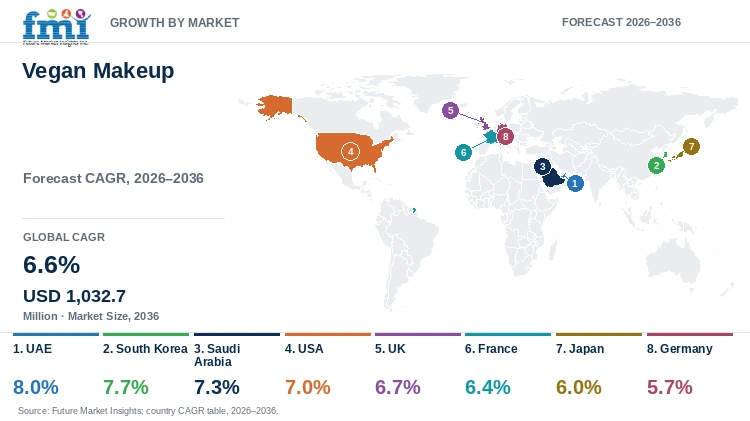
Country
CAGR
UAE
8.0%
South Korea
7.7%
Saudi Arabia
7.3%
USA
7.0%
UK
6.7%
France
6.4%
Japan
6.0%
Germany
5.7%
- UAE: At 8.0% CAGR from 2026 to 2036, the UAE has the fastest growth among the countries profiled. Imported eye and facial makeup falls within Ministry of Industry and Advanced Technology conformity requirements. Dubai Municipality also operates Montaji registration for consumer products. Vegan makeup brands therefore need the technical file and local registration work ready before distribution begins. [12][13]
- South Korea: Vegan makeup has a visible place in the mainstream beauty market. Amorepacific launched vegan-certified HERA Blush in July 2024 through online and department-store channels. [15] The Cosmetics Act restricts cosmetics tested on animals and products made with animal-tested raw materials, subject to statutory exceptions. [14] South Korea is forecast to grow at a 7.7% CAGR through 2036. Shade quality and texture remain important to winning repeat purchases.
- Saudi Arabia: L’Oréal identified online sales as an important growth driver in Saudi Arabia in its 2024 results. [17] Cosmetic products require Saudi Food and Drug Authority notification before marketing. [16] At a 7.3% CAGR from 2026 to 2036, the forecast points to room for expansion when local notification and Arabic-language product information are in place.
- USA: MoCRA requires covered manufacturers and processors to register facilities. Responsible persons must list marketed products and ingredients with FDA, subject to exemptions. [3] The USA is forecast to grow at a 7.0% CAGR from 2026 to 2036. e.l.f. and Smashbox show how vegan makeup products can reach buyers through large digital and retail channels. [18][6]
- UK: Products launched in Great Britain need both ordinary cosmetics documentation and support for vegan claims. Government guidance requires a UK-established Responsible Person and applicable notification before market placement. [19] The UK is forecast to grow at a 6.7% CAGR through 2036. Clear claim wording is part of routine launch preparation.
- France: Cosmetic claims face close scrutiny. In November 2023 the DGCCRF reported anomalies at 40% of operators checked for “free-from” claims. [10] Its 2025 clarification stated that wording such as “without ingredients or substances of animal origin” can be equivalent to vegan when properly supported. [20] France is forecast to grow at a 6.4% CAGR from 2026 to 2036. Clear raw-material records help brands substantiate these claims.
- Japan: Texture and finish shape makeup competition. Kao opened the first global KATE flagship in Shibuya in July 2024, while Shiseido promoted its serum-first foundation concept that year. [22][23] Vegan formulas enter the same competitive setting and remain subject to Japanese cosmetic standards. [21] Japan is forecast to grow at a 6.0% CAGR from 2026 to 2036. Color and sensory performance remain important alongside ingredient origin.
- Germany: At a 5.7% CAGR from 2026 to 2036, Germany has the lowest forecast growth rate among the countries profiled. The Federal Institute for Risk Assessment explains that cosmetics do not require EU pre-market authorisation. Safety responsibilities and notification requirements still apply. Vegan makeup suppliers also need ingredient-origin records to support their claims. [24]
Who are the notable companies in the vegan makeup market?
Kao Corporation, Procter & Gamble, Estee Lauder Companies, e.l.f. Beauty, L’Oreal, Beiersdorf, Coty, Amorepacific, Unilever, and Shiseido are the notable companies profiled in this market.
e.l.f. Cosmetics and Hourglass under Unilever have brand-wide vegan policies. Hourglass says it has been fully vegan since 2020. [18][26] Coty relaunched Kylie Cosmetics with vegan formulas. [7] Smashbox and Chantecaille offer vegan makeup assortments under Estee Lauder Companies and Beiersdorf respectively. [32][27]
NYX, HERA and NARS identify specific vegan makeup formulas. [29][15][28] Kao participates in makeup through KATE. Vegan makeup participation is not specified for Kao or Procter & Gamble in the cited company information. [22][31]
- Brand-wide vegan propositions: e.l.f. Beauty, Coty through Kylie Cosmetics, and Unilever through Hourglass.
- Vegan assortments or individual products: Estee Lauder Companies, L’Oreal, Beiersdorf, Amorepacific and Shiseido.
- Other profiled beauty companies: Kao Corporation and Procter & Gamble.
Competitive Benchmarking: Vegan Makeup Market
Company
Vegan Formula Breadth
Claim Support
Makeup Channels
Geographic Reach
Kao Corporation
Vegan range not specified
Vegan makeup claim not specified
KATE flagship retail [22]
KATE makeup activity in Japan and Asia
Procter & Gamble
Vegan range not specified
Vegan makeup claim not specified
Vegan makeup channel not specified [31]
Global beauty operations
Estee Lauder Companies
Smashbox vegan assortment [32]
Product and assortment claims
Prestige retail and Amazon [6]
International prestige makeup through Smashbox
e.l.f. Beauty
Brand-wide vegan positioning [18]
Brand vegan policy
Retail and DTC [35][36]
United States plus expanding European and international retail and DTC
L’Oreal
Selected NYX vegan formulas [29]
Product-level claims
Mass beauty retail
Europe, North America, Asia and emerging beauty markets
Beiersdorf
Chantecaille vegan collection [27]
Collection and product claims
Prestige beauty channels
Chantecaille prestige channels and vegan makeup collection
Coty
Kylie Cosmetics vegan formulas [7]
Brand and formula claims
Selected retail and DTC
United States, Europe, UK, Australia and global DTC through Kylie Cosmetics
Amorepacific
HERA vegan blush [15]
Product vegan certification
Online and department stores
South Korea and selected international beauty markets
Unilever
Hourglass vegan brand [26]
Brand vegan policy
Prestige beauty channels
International Hourglass prestige beauty channels
Shiseido
NARS vegan foundation [28]
Product-level claim
Prestige beauty channels
NARS prestige channels
Vegan claims apply to the brands, collections or products identified in the table. Parent-company ownership does not establish a vegan claim for every product.
Key Developments in the Vegan Makeup Market
- In May 2025, e.l.f. Beauty expanded e.l.f. Cosmetics into KRUIDVAT and TREKPLEISTER stores in the Netherlands and Belgium. The company described the brand as offering clean and vegan products. The expansion added more opportunities for in-store trial alongside its digital channels and accessible pricing. [35]
- In August 2024, Estee Lauder Companies launched Smashbox in the U.S. Amazon Premium Beauty store. The announcement described the brand as cruelty free and identified Photo Finish primer as vegan and cruelty-free. The launch made its prestige makeup assortment available to more marketplace shoppers. [6]
- In July 2024, Amorepacific launched HERA Blush in South Korea. It described the product as vegan certified with a 95% natural-origin index. Online platforms and department-store counters carried the launch, placing the certified formula in established premium beauty channels. [15]
Key Players in the Vegan Makeup Market
Brand-level vegan platforms
- e.l.f. Beauty
- Coty
- Unilever
Vegan assortments or individual products
- Estee Lauder Companies
- L’Oreal
- Beiersdorf
- Amorepacific
- Shiseido
Other profiled beauty companies
- Kao Corporation
- Procter & Gamble
Vegan Makeup Market – Report Scope
Coverage field
Report scope
Market breakdown
Product Type; Nature; Format; Price Positioning; Sales Channel
Quantitative Units
USD Million
Market Definition
Revenue includes vegan makeup products sold within the stated segmentation universe, including face, eye, lip, cheek, complexion, primer, setting, and kit products where the makeup offer is marketed as vegan or animal-ingredient-free. Revenue excludes adjacent <a Oreal; Beiersdorf; Coty; Amorepacific; Unilever; Shiseido
Forecast Period
2026 to 2036
Approach
Primary and secondary research with market triangulation.
Vegan Makeup Market – Research Methodology
Method
Approach
Primary Research
FMI’s primary research framework examines purchasing criteria and claim documentation with manufacturers, distributors, buyers and subject-matter experts. It also covers channel requirements and product-approval workflows. For vegan makeup, the focus is on product performance and ingredient-origin records alongside market access.
Desk Research
Desk research draws on regulatory publications, industry sources and company filings alongside official product information and announcements. Sources are assessed against the market definition, geography and period. Vegan formulation claims are distinguished from cruelty-free testing claims.
Market Sizing and Forecasting
Sizing combines baseline market values with the segment structure, pricing indicators and country conditions. Estimates are compared with demand patterns and company information before segment and country forecasts are reconciled.
Data Validation
Revenue is checked against the vegan makeup definition. Adjacent skincare and fragrance are excluded, as are standalone tools and salon services. Cruelty-free products qualify only when animal-free formulation is also established.
Vegan Makeup Market by Segments
Vegan Makeup Market segmented by Product Type:
- Core / classic lines
- Targeted treatment lines
- Sensitive & gentle lines
- Premium & clinical lines
- Kits & sets
Vegan Makeup Market segmented by Nature:
- Conventional
- Vegan & cruelty-free
- Natural & organic
- Dermocosmetic / clinical
- Fragrance-free & sensitive
Vegan Makeup Market segmented by Format:
- Cream & balm
- Liquid & serum
- Stick & solid
- Spray & mist
- Sheet & patch
- Powder
Vegan Makeup Market segmented by Price Positioning:
- Mass
- Masstige
- Premium
- Professional
Vegan Makeup Market segmented by Sales Channel:
- E-commerce & DTC
- Specialty beauty retail
- Pharmacies & drugstores
- Supermarkets & hypermarkets
- Salons & spas
Vegan Makeup Market by Region:
- North America
- United States
- Canada
- Latin America
- Brazil
- Mexico
- Argentina
- Chile
- Western Europe
- Germany
- France
- United Kingdom
- Italy
- Spain
- Benelux
- Nordics
- Eastern Europe
- Poland
- Czech Republic
- Romania
- Hungary
- East Asia
- China
- Japan
- South Korea
- South Asia and Pacific
- India
- ASEAN
- Australia and New Zealand
- Middle East and Africa
- GCC Countries
- South Africa
- Türkiye
- Israel
Research
- [1]The Vegan Society (14 March 2024). The impact of
<li>[3]FDA (9 September 2026).
