


InfographicsCompanies
Market Size (2026)
USD 329.4 Mn
Forecast (2036)
USD 636.0 Mn
CAGR (2026 to 2036)
6.8%
How Big is the Cosmetic-Grade Tranexamic Acid Market in 2026?
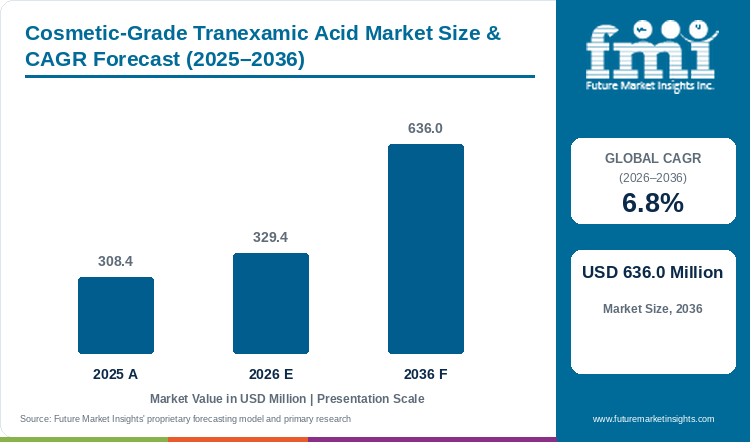
Brands and formulators will spend USD 329.4 Million on cosmetic-grade tranexamic acid in 2026, up from USD 308.4 Million in 2025. Revenue will rise to USD 636.0 Million by 2036 at a 6.8% CAGR.
Adoption of cosmetic-grade tranexamic acid is projected to rise at 6.8% CAGR between 2026 and 2036 Market valuation increases from USD 308.4 Million in 2025 to USD 329.4 Million in 2026 and is expected to reach USD 636.0 Million by 2036, creating an additional opportunity of USD 306.6 Million
Increasing clinical evidence for topical use is supporting the demand for tranexamic acid in tone-correction skincare. A 2025 randomized trial found that a 5% topical tranexamic acid cream cut melasma severity scores by 50.88% over 12 weeks [1]. Due to this, more brands are moving from appearance-led facial formulas toward pigmentation claims, and these programs pay a higher price per kilogram for purity and efficacy files. As per FMI’s analysis, standard grade is expected to hold 43% of demand by product type and standard cosmetic grade 44% of demand by grade in 2026. High-purity and clinical grades are projected to take a larger share of new demand through 2036.
Demand for cosmetic-grade tranexamic acid is developing differently across countries, owing to local pigmentation claim rules. The UAE is projected at 8.2% CAGR through 2036, and Japan is forecast at 5.9% as quasi-drug brightening products are already well established. Japanese quasi-drug products list tranexamic acid as an active ingredient, and Daiichi Sankyo Healthcare launched a quasi-drug brightening facial mask on February 13, 2026 with tranexamic acid named as an active [2]. South Korea reviews whitening functional cosmetics with safety and effectiveness data, due to which buyers in both countries are paying for pharma and clinical grade. US rules treat claims to change melanin production as a sign of drug intent, and US brands are keeping tone language at the appearance level with standard cosmetic grade.
Finished brightening products are expected to grow faster than the ingredient during the forecast period. Sales of skin lightening products are projected to rise from USD 23.2 Billion in 2026 to USD 47.9 Billion by 2036 at 7.5% CAGR, an opportunity of USD 24.7 Billion. The hyperpigmentation lighteners market is growing faster at 9.3%, from USD 7,201.3 Million in 2025 to USD 17,502.3 Million by 2035. Demand for cosmetic chemicals is estimated to increase at a slower 5.6% CAGR, from USD 17.2 Billion to USD 29.7 Billion. As a result, tranexamic acid will grow faster than the wider pool of formulation inputs. FMI predicts that adoption of documented higher-priced grades will increase through 2036, moving a growing part of the USD 306.6 Million gain toward suppliers with purity and claim support files.
Key Takeaways
- Notable companies in the cosmetic-grade tranexamic acid market include BASF, DSM-Firmenich, Givaudan, Symrise, Croda, Evonik, Lubrizol and Ashland.
- Based on product type, standard grade is projected to account for 43% in 2026, owing to routine cosmetic documentation at the lowest price per kilogram.
- By function, anti-aging is estimated to hold 26% in 2026, as premium well-aging formulas carry the cost of a documented grade, and facial skincare is expected at 40% by application.
- In 2026, standard cosmetic grade is expected to account for 44% by grade, and direct to brands is projected at 48% by sales channel, supported by technical exchange on certificates and claim wording.
- The UAE is projected at 8.2% CAGR through 2036, followed by Saudi Arabia at 7.9%, as imported premium beauty brands widen shelf presence and updated cosmetic rules raise the value of documented ingredients.
Analyst Perspective
“High-purity tranexamic acid sold with efficacy and stability files into Korean functional-cosmetic and Japanese quasi-drug programs will receive the strongest price premium. Suppliers pairing the active with encapsulated delivery systems will gain the larger share of new brightening serum orders.”
– , Principal Consultant, Future Market Insights
How is the Cosmetic-Grade Tranexamic Acid Market Segmented?
The cosmetic-grade tranexamic acid market is segmented into product type, function, application, grade, sales channel and region.
As per FMI, the market is segmented by product type into standard grade, high-purity and clinical grade, natural and certified grade, and customized systems. By function, the market is segmented into anti-aging, hydration and barrier, brightening, soothing and sensitive, and UV and protection. By application, the market is segmented into facial skincare, body care, haircare, color cosmetics and suncare. By grade, the market is segmented into standard cosmetic grade, COSMOS and natural certified, pharma and clinical grade, and organic certified. By sales channel, the market is segmented into direct to brands, specialty distributors, contract manufacturers and online B2B. The regional analysis covers seven regions and more than 25 countries.
Why Does Standard Grade Lead the Cosmetic-Grade Tranexamic Acid Market by Product Type?
Standard grade is widely used by skincare brands launching high-volume products with cosmetic tone claims. Such launches only need routine quality papers covering purity tests and identification at a low cost per kilogram, due to which formulators select this grade for early batches and large rollouts. Customized systems pair the active with a carrier technology and cost more per kilogram, skincare products, supporting the demand for standard cosmetic grade. Brands avoid paying for stricter specifications on everyday tone products, due to which this grade gets the biggest portion of purchase orders. Clean-beauty brands buy COSMOS and natural certified and organic certified grades, and audit costs plus thin certified supply keep these volumes small compared with the wider lightening and whitening agents market. Pharma and clinical grade is growing at a slower pace, as the higher price pays off mainly in quasi-drug and functional-cosmetic programs. However, the rules for registering claims in Japan and South Korea will decide the portion of new launches moving to pharma and clinical grade.
- Standard cosmetic grade is projected to hold 44% of demand by grade in 2026, owing to appearance-led tone claims in US and European launches.
- Registered brightening claims in Japanese and Korean programs are expected to add volume for pharma and clinical grade.
Why Does Direct-to-Brand Supply Lead the Cosmetic-Grade Tranexamic Acid Market by Sales Channel?
Based on sales channel, direct to brands will account for 48% of market share in 2026.
Brand formulators are buying more cosmetic-grade tranexamic acid straight from producers for programs needing technical exchange. Choice of grade, certificate packages and permitted claim wording are agreed with the producer ahead of the first purchase, due to which direct to brands accounts for the biggest part of sales. Online B2B is growing at a slower pace, as small brands order standard grade in low quantities with no technical service. Contract manufacturers purchase mostly to a specification set by the brand owner and represent a smaller share. Specialty distributors supply customers wanting nearby inventory, local-language help and regulatory dossiers. However, distributor appointments in each region will decide response times for brands lacking a dedicated account team at the producer.
- Direct to brands is estimated to account for 48% of demand by sales channel in 2026, supported by technical exchange on certificates, stability data and claim wording.
- In June 2026, DSM-Firmenich appointed TER Chemicals as exclusive Beauty & Care distributor in Germany and the Netherlands, effective August 1, 2026 [5].
What are the Drivers, Restraints, and Opportunities in the Cosmetic-Grade Tranexamic Acid Market?
According to FMI, topical clinical evidence is pulling brands toward tranexamic acid, weak skin penetration and claim limits are slowing conversion, and encapsulated delivery systems will open the higher-priced revenue pool till 2036.
- Driver: Randomized trial data on topical use are supporting adoption of tranexamic acid, as skincare teams can qualify the active more easily for tone-correction formulas.
- Restraint: Low penetration through the outer skin and claim-sensitive rules are extending formulation, substantiation and launch timelines for brands.
- Opportunity: Encapsulation and delivery platforms can turn a commodity active into a higher-priced formulation system for brightening brands.
Increasing topical evidence is supporting the purchase case for tranexamic acid in skincare. In the Heidary trial published in <a s severity score fell from 7.94 to 4.04 over 12 weeks [1]. Delivery platforms are also developing in the same direction, as Givaudan built VectorHyal on over 20 years of encapsulation research and designed the system for deeper penetration, gradual release and protection of sensitive molecules [3].
Key challenges in the cosmetic-grade tranexamic acid market are skin delivery and claim wording. Tranexamic acid is a water-soluble molecule with low penetration through the outer skin, due to which brands need vehicle, concentration and stability data before scale-up. Claim wording is acting as a second filter, as language about melanin production can move a product into drug or quasi-drug review. Suppliers offering stability files, delivery options and claim guidance together are expected to shorten qualification.
Which Country CAGRs are Profiled in the Cosmetic-Grade Tranexamic Acid Market?
Country
CAGR, 2026 to 2036
UAE
8.2%
Saudi Arabia
7.9%
South Korea
7.5%
USA
7.2%
UK
6.9%
France
6.6%
Germany
6.3%
Japan
5.9%
How do Country-level CAGRs Compare in the Cosmetic-Grade Tranexamic Acid Market?
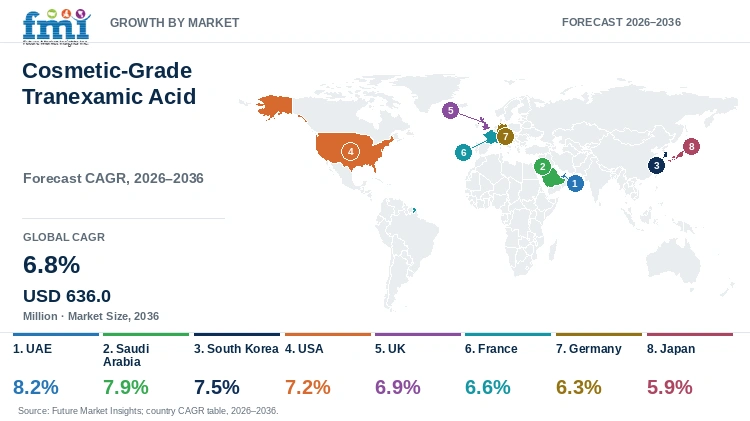
Demand for cosmetic-grade tranexamic acid across the eight profiled countries falls into three growth bands, as per FMI’s analysis. The UAE, Saudi Arabia, South Korea and the USA are projected at 7.2% or above, the UK, France and Germany are expected to grow between 6.3% and 6.9%, and Japan is forecast at 5.9%. Growth pace is following claim rules and category maturity, and mature markets such as Japan will continue to carry a long-established base of tranexamic acid brightening products.
- UAE leads at 8.2% as imported premium beauty brands widen shelf presence.
- Saudi Arabia follows at 7.9%, with updated cosmetic rules raising the value of documented ingredients.
- Functional-cosmetic review for whitening claims will carry South Korea to 7.5%.
- Growth of 7.2% in the USA will track appearance-level tone claims under MoCRA.
- Demand for cosmetic-grade tranexamic acid in the UK will rise at 6.9% as Responsible Persons manage safety files for every product.
- France will expand at 6.6% on a large export-led formulation and manufacturing base.
- Germany grows at 6.3% as regional distribution adds local technical support.
- Japan grows slowest at 5.9%, with quasi-drug brightening products already well established.
Growth rates for the remaining markets across seven regions and over 25 countries and country groups appear in the full report beside these eight profiles.
Country Outlook
- French cosmetics exports to the UAE rose 8% in 2025, a sign of active demand for imported beauty products in the Gulf hub [6]. Demand for cosmetic-grade tranexamic acid in the UAE is projected to rise at 8.2% CAGR, the fastest of the profiled countries. Suppliers shipping consistent specifications with accredited test reports are expected to convert distributor trials faster.
- SFDA added three restricted ingredients with new concentration limits in August 2025 and extended the prohibited list by 21 substances in September 2025, and every shipment needs a valid certificate of conformity [7]. Demand in Saudi Arabia is forecast to grow at 7.9% CAGR through 2036. Documented ingredient identity is guiding supplier selection for brightening launches in the Kingdom.
- South Korea exported USD 11.43 billion of cosmetics in 2025, with skincare at USD 8.54 billion, according to the Ministry of Food and Drug Safety [8]. Whitening products pass a functional-cosmetic review with safety and effectiveness data, and demand in South Korea is expected to expand at 7.5% CAGR through 2036. High-purity grade with full documentation will carry a premium in this pathway.
- At a 7.2% CAGR, the USA will grow inside a large and newly visible cosmetics base. FDA counted 16,398 active facility registrations and 1,298,361 active product listings as of June 30, 2026 [9]. Melanin-related wording can signal drug intent, due to which US brands are expected to buy standard cosmetic grade for appearance claims and keep therapeutic language off the pack.
- UK cosmetics compliance runs through Responsible Persons, and the government counted 861,686 product notifications through SCPN and 24,112 registered Responsible Persons as of May 28, 2026 [10]. UK sales will rise at a 6.9% CAGR, with suppliers providing ready safety and technical files gaining faster brand onboarding.
- French cosmetics exports reached EUR 22.4 billion in 2025, a 0.1% decline after a 19% drop in shipments to the USA, with makeup and skincare at EUR 11 billion of the total [6]. A deep base of formulators and contract manufacturers will support a 6.6% CAGR, and EU claim criteria will keep brightening wording proportionate to the evidence.
- Germany will grow at a 6.3% CAGR, the lowest rate among the three profiled Western European countries. Regional distribution is strengthening, as DSM-Firmenich named TER Chemicals exclusive Beauty & Care distributor for Germany and the Netherlands from August 1, 2026 [5]. Batch consistency and responsive technical service will carry the most weight in German supplier reviews.
- Japan grows slowest at 5.9%, as tranexamic acid already holds a settled role in quasi-drug brightening care. Daiichi Sankyo Healthcare released the Transino Medicated Brightening Facial Mask on February 13, 2026, listing tranexamic acid and dipotassium glycyrrhizinate as active ingredients [2]. Growth will come from new formats and higher-purity supply for established brands.
Who are the Notable Companies in the Cosmetic-Grade Tranexamic Acid Market?
Competition among the beauty-ingredient suppliers profiled by FMI, including BASF, DSM-Firmenich, Givaudan, Evonik, Clariant and Croda, turns on grade documentation, delivery systems and technical service.
Tranexamic acid is a generic active, due to which beauty-ingredient platforms compete through documentation, delivery and service around the same molecule, and supply remains fragmented. Skin-science platforms are selling active portfolios backed by clinical data, as Croda showed with the June 2026 launch of Malvallin [4]. Delivery specialists are competing on penetration and stability, and Givaudan unveiled the VectorHyal encapsulation system at in-cosmetics Global 2026 in Paris [3]. Channel reach is also shaping supplier choice, as DSM-Firmenich handed Beauty & Care distribution in Germany and the Netherlands to TER Chemicals [5]. Brands repeat stability and safety work before changing an active supplier, owing to which purity certificates, stability data and claim support keep new suppliers out. Pricing power is expected to move toward suppliers selling high-purity grade with delivery systems into quasi-drug and functional-cosmetic programs. However, standard grade will continue to face steady price competition through 2036.
- Skin-Science and Active Platforms: BASF, DSM-Firmenich, Givaudan, Symrise and Croda supply broad skin-active portfolios backed by clinical and formulation science.
- Formulation and Delivery Specialists: Evonik, Lubrizol and Clariant add delivery technology, application laboratories and formulation support for active ingredients.
- Functional Ingredients and Channel Support: Ashland and IFF combine functional and bioactive ingredients with broad personal-care customer access.
Competitive Benchmarking
Company
Cosmetic Actives Depth
Delivery & Formulation Systems
Beauty Channel Infrastructure
Geographic Reach
Evonik
High
High
High
Europe, Asia-Pacific and global beauty markets
Ashland
High
Low
High
United States and global personal-care markets
Lubrizol
Medium
High
High
Americas, Europe, Asia and global personal-care markets
Clariant
High
High
High
Europe, Asia and global personal-care markets
BASF
High
High
High
Europe, Americas, Asia-Pacific and global cosmetics markets
DSM-Firmenich
High
Medium
High
Europe and global Beauty & Care markets
Givaudan
High
High
Medium
Europe and global Active Beauty markets
Symrise
High
Low
Medium
Europe and global Care & Wellness markets
IFF
Medium
Low
Medium
Americas, Europe and global beauty markets
Croda
High
Medium
Medium
Europe, Asia and global beauty markets
Scoring basis: Cosmetic Actives Depth is High for a documented broad skin-active portfolio and Medium for a narrower relevant set. Delivery & Formulation Systems is High for documented advanced delivery or application platforms and Medium for narrower formulation support. Beauty Channel Infrastructure is High for multi-market beauty access with technical or distribution support and Medium for more limited evidence. A Low rating marks limited public documentation for the criterion.
Key Developments
- In March 2026, Givaudan Active Beauty unveiled VectorHyal at in-cosmetics Global in Paris, an encapsulation and hyaluronic acid delivery system for water-soluble and oil-soluble cosmetic actives [3].
- In June 2026, DSM-Firmenich appointed TER Chemicals as exclusive distributor of the Beauty & Care portfolio in Germany and the Netherlands, effective August 1, 2026 [5].
- In June 2026, Croda launched Malvallin, a naturally derived skincare active from Chinese mallow fruit supporting firmness, hydration, elasticity and visible facial volume [4].
Key Players
Skin-Science and Active Platforms
- BASF
- DSM-Firmenich
- Givaudan
- Symrise
- Croda
Formulation and Delivery Specialists
- Evonik
- Lubrizol
- Clariant
Functional Ingredients and Channel Support
- Ashland
- IFF
Report Scope and Methodology
Coverage field
Report scope
Market breakdown
5 categories plus region: Product Type (Standard grade, High-purity / clinical grade, Natural & certified grade, Customized systems), Function (Anti-aging, Hydration & barrier, Brightening, Soothing & sensitive, UV & protection), Application (Facial skincare, Body care, Haircare, Color cosmetics, Suncare), Grade (Standard cosmetic grade, COSMOS / natural certified, Pharma & clinical grade, Organic certified), Sales Channel (Direct to brands, Specialty distributors, Contract manufacturers, Online B2B), and Region
Quantitative units
USD Million
Market definition
Revenue from cosmetic-grade tranexamic acid sold across the report segments, including supplier-defined systems with tranexamic acid as the principal billable ingredient. Downstream finished products, oral or injectable pharmaceutical tranexamic acid, chemical derivatives, substitute brightening ingredients and services not separately attributable to tranexamic acid are excluded.
Regions covered
North America, Latin America, Western Europe, Eastern Europe, East Asia, South Asia and Pacific, Middle East and Africa
Countries covered
Over 25 national and grouped markets, with the USA, Germany, France, the UK, Saudi Arabia, the UAE, Japan and South Korea profiled in detail
Key companies profiled
Evonik, Ashland, Lubrizol, Clariant, BASF, DSM-Firmenich, Givaudan, Symrise, IFF and Croda, selected from a wider field of beauty-ingredient suppliers
Forecast period
2026 to 2036
Approach
Ingredient volumes, grade pricing and supplier revenue indicators triangulated from primary interviews and secondary sources.
Research Methodology
Method
Approach
Primary research
Interviews with ingredient manufacturers, distributors, brand formulators, contract manufacturers, procurement teams and regulatory specialists test grade selection, approval requirements and pricing, plus the evidence a brand asks for before a sample order turns into regular purchasing.
Desk research
The analysis reviews regulatory publications, clinical literature, trade data, industry associations, company filings, product information and corporate announcements. Sources are retained for relevance, publication date, geographic coverage and fit with the defined market scope.
Market sizing and forecasting
Baseline value is built up through segment splits, grade prices and volumes, adoption in finished formulas, supplier participation and demand conditions in each country. Claim regulation, technology adoption, purchasing cycles and supply availability shape the forecast path.
Data validation
Public data, company activity, trade patterns and interview findings serve as cross-checks on each estimate. Adjacent categories, overlapping revenues and unverified claims are removed so no revenue is counted twice across segments or countries.
Cosmetic-Grade Tranexamic Acid Market by Segments
Cosmetic-Grade Tranexamic Acid Market Segmented by Product Type
- Standard grade
- High-purity / clinical grade
- Natural & certified grade
- Customized systems
Cosmetic-Grade Tranexamic Acid Market Segmented by Function
- Anti-aging
- Hydration & barrier
- Brightening
- Soothing & sensitive
- UV & protection
Cosmetic-Grade Tranexamic Acid Market Segmented by Application
- Facial skincare
- Body care
- Haircare
- Color cosmetics
- Suncare
Cosmetic-Grade Tranexamic Acid Market Segmented by Grade
- Standard cosmetic grade
- COSMOS / natural certified
- Pharma & clinical grade
- Organic certified
Cosmetic-Grade Tranexamic Acid Market Segmented by Sales Channel
- Direct to brands
- Specialty distributors
- Contract manufacturers
- Online B2B
Cosmetic-Grade Tranexamic Acid Market Segmented by Region
- North America
- Latin America
- Western Europe
- Eastern Europe
- East Asia
- South Asia and Pacific
- Middle East and Africa
Research
- [1] Heidary, B., Meibodi, G. A. H., Ardakani, M. E., Ramezani, V., & Heidari, F. (2025, September 9).
<li>[3] Givaudan (2026, March 17).
